

A programmable bidirectional DC power supply is a versatile electronic instrument that can both source (supply) and sink (absorb) power, enabling controlled bidirectional energy flow between DC systems. Unlike traditional unidirectional power supplies that only deliver power, these devices can operate in two-quadrant or four-quadrant modes, meaning they can switch between supplying power to a load and absorbing power from a load. This flexibility makes them indispensable in modern engineering for applications such as battery testing, renewable energy, electric vehicles, and power electronics research. In this article, we will explore the key features of programmable bidirectional DC power supplies and highlight their wide-ranging applications, followed by the significant advantages they offer over conventional solutions.
Key Features of Programmable Bidirectional DC Power Supplies
-
Programmable bidirectional DC power supplies combine the functionality of a DC power source and an electronic load into one device. They are equipped with advanced control and monitoring capabilities, allowing users to precisely set and sequence voltage and current levels in both sourcing and sinking modes. Here are some of the key features:
-
Two/Quadrant Operation: These power supplies can operate in two-quadrant mode (sourcing and sinking) or four-quadrant mode, depending on the model. In two-quadrant mode, they can source power (deliver voltage and current) or sink power (absorb energy) but not both simultaneously. In four-quadrant mode, they support bidirectional power transfer and can switch between sourcing and sinking without interruption. For example, a bidirectional supply can charge a battery (source mode) and then discharge it back (sink mode) without manual intervention. This seamless transition between charging and discharging is enabled by sophisticated control algorithms that manage the power flow in both directions.
-
High Efficiency and Regenerative Loading: Modern bidirectional power supplies are engineered for high efficiency, especially when operating in sink (load) mode. They typically include a regenerative load feature that can feed the absorbed energy back into the AC grid with high efficiency (often 90–96%). This means instead of dissipating power as heat, the supply can return it to the local utility or facility. This not only saves energy costs but also reduces the need for additional cooling systems. The high efficiency is achieved through advanced power conversion techniques and can significantly lower operational expenses over time.
-
Programmable Control: These supplies are fully programmable, allowing users to set output voltage, current, and power in both source and sink modes with high precision. They often support multiple operating modes such as constant voltage (CV), constant current (CC), constant power (CP), and constant resistance (CR), depending on the load conditions. Some models even include a built-in arbitrary waveform generator for simulating complex voltage or current profiles. This programmability is essential for testing dynamic scenarios and simulating real-world conditions. For instance, a bidirectional supply can be programmed to output a specific voltage/current waveform that mimics a battery’s behavior or a load’s varying demand.
-
Communication Interfaces: Bidirectional power supplies come with modern communication interfaces for integration into automated test systems. Common interfaces include USB, GPIB, Ethernet, and RS-232, enabling seamless control via computers or test benches. They support protocols like SCPI (Standard Commands for Programmable Instruments) and can be controlled via software or programming languages. This connectivity allows users to automate testing sequences, log data, and remotely monitor the supply’s performance. Many suppliers provide software tools for data acquisition and visualization, which are invaluable in research and development environments.
-
High-Speed Response and Transient Handling: Advanced models feature fast transient response times, enabling them to react quickly to changes in load conditions. This is crucial for testing components that experience rapid voltage or current changes, such as power electronics converters or battery packs. Some bidirectional power supplies can achieve sub-millisecond transient response, ensuring stable operation even under varying loads. Additionally, they may include features like voltage/current slew rate control and automatic line loss compensation to smooth out any overshoots or voltage drops during mode transitions.
-
Protection and Safety Features: To ensure safe operation, bidirectional power supplies are equipped with built-in protection mechanisms. These include overvoltage protection (OVP), overcurrent protection (OCP), overpower protection (OPP), thermal overload protection (OTP), and low voltage protection (LVP). In sink mode, the supply monitors the DC bus voltage and can detect if the energy feedback path is disrupted (grid outage or failure), automatically shutting down to prevent damage. The devices also feature galvanically isolated interfaces and high-voltage insulation, adhering to safety standards. These protections safeguard both the supply and the connected devices, ensuring reliable operation even in complex test setups.
-
User Interface: Most bidirectional power supplies come with an intuitive front panel interface, often including a color LCD display and knobs or touchscreen controls. This allows local operation and monitoring of the output parameters. Some models offer additional features like a built-in digital oscilloscope or waveform analyzer to visualize the output characteristics in real-time. The user interface is designed to make it easy to switch between source and sink modes, set operating limits, and view status indicators.
In summary, programmable bidirectional DC power supplies are highly advanced instruments that offer precise control, fast response, and energy-efficient operation in both sourcing and sinking modes. Their combination of power supply and load capabilities, along with advanced control features, makes them ideal for a wide range of testing and simulation tasks.
Applications of Programmable Bidirectional DC Power Supplies
The versatility of programmable bidirectional DC power supplies makes them indispensable in various industries and applications. Below are some of the key areas where these devices are commonly used:
Battery Testing and Characterization
One of the primary applications of bidirectional power supplies is battery testing. These supplies can charge batteries under controlled conditions and then discharge them to simulate real-world usage scenarios. For example, engineers use bidirectional DC power supplies to perform battery life cycle tests, where a battery is repeatedly charged and discharged to evaluate its capacity and performance over time. The ability to both source and sink power allows for precise control of the charge/discharge current and voltage, ensuring that the battery is tested under conditions that mimic actual usage. This is essential for validating battery management systems (BMS) and improving battery designs.
Bidirectional power supplies can also act as battery simulators, emulating the behavior of a battery cell or pack. By programming the supply to have a specific open-circuit voltage (OCV) versus state-of-charge (SOC) curve and an internal resistance, the output voltage can naturally sag during discharge or rise during charging, just like a real battery. This capability is used to test the response of charging systems, inverters, and other devices to battery-like dynamics. Chroma, for instance, offers bidirectional power supplies with features for battery characterization and battery simulation, which are critical for EV and renewable energy applications.
In summary, programmable bidirectional DC power supplies enable efficient and comprehensive battery testing, from charge acceptance tests to cycle life evaluations, all in a controlled environment.
Renewable Energy and Solar Power
Programmable bidirectional DC power supplies play a crucial role in the development and testing of renewable energy systems, such as solar and wind power converters. In solar PV systems, a bidirectional supply can be used to simulate the output of a solar panel array (a DC source) and test how an inverter or charge controller behaves under varying conditions. For example, a bidirectional power supply can generate a solar cell I-V curve to test the static maximum power point tracking (MPPT) efficiency of a PV inverter. Some suppliers even provide software that incorporates standard I-V curves for photovoltaic cells (e.g. Sandia or EN50530) to automate these tests.
In wind energy systems, bidirectional supplies can be used to test power converters and inverters that interface with the grid. By acting as a controllable AC or DC source, the supply can simulate grid voltage and frequency changes, allowing engineers to test how the wind turbine’s power electronics respond to grid anomalies (voltage dips, sags, swells, etc.). Additionally, bidirectional power supplies are used to evaluate the performance of battery storage systems integrated with renewable energy sources. They can charge the battery from the solar/wind source and then discharge it back into the grid or a load, helping to test the power flow control and stability of the system.
Overall, bidirectional power supplies enable simulation of grid conditions and renewable energy sources, making them essential for validating the robustness and efficiency of renewable energy conversion systems.
Electric Vehicle and Mobility Systems
The automotive industry is leveraging programmable bidirectional DC power supplies for a variety of applications, especially in electric vehicles (EVs) and hybrid vehicles. One major use case is EV charging system testing. Bidirectional power supplies can simulate both a power grid and a battery in a test environment, allowing engineers to test EV chargers (on-board and off-board) under various conditions. For example, a bidirectional supply can be set to act as a grid simulator (providing AC voltage and current) and simultaneously supply DC power to an EV charger, while also monitoring the charger’s response. This setup helps verify the charger’s compliance with charging standards and its ability to handle bidirectional power flow (charging the battery and, in the future, potentially feeding power back to the grid or another vehicle).
Bidirectional power supplies are also used in the development of battery management systems (BMS) for EVs. They can charge and discharge battery packs to test how the BMS controls the current and voltage, ensuring safe operation and optimal performance. Additionally, they are used to evaluate regenerative braking systems in EVs. During regenerative braking, the vehicle’s motor acts as a generator, converting kinetic energy back into electrical energy that charges the battery. A bidirectional supply can simulate this scenario by absorbing power from a load (representing the vehicle’s braking system) and feeding it back to the battery, thus testing the energy recovery and management processes. This testing is crucial for optimizing regenerative braking efficiency and ensuring the system can handle the dynamic changes in power flow.
Beyond EVs, bidirectional power supplies are used in hybrid electric vehicles (HEVs) and electric aircraft to test the power electronics that manage the battery and generator power flows. For instance, in hybrid aircraft, a bidirectional supply can simulate the battery and the engine/generator, allowing engineers to test the power distribution and control between them. The aerospace industry has seen a surge in demand for high-performance bidirectional power supplies as it accelerates toward electrification of aircraft, from hybrid-electric planes to advanced UAVs.
In summary, programmable bidirectional DC power supplies are indispensable in EV and mobility testing, enabling the validation of charging infrastructure, battery systems, and power electronics in both electric and hybrid vehicles.
Power Electronics Research and Development
In research and development (R&D) labs, bidirectional DC power supplies are used extensively for testing and characterizing power electronic devices and systems. They allow researchers to simulate a wide range of load conditions and power sources, which is essential for studying the behavior of components like converters, inverters, and rectifiers. For example, a bidirectional supply can be used to test a DC-DC converter’s ability to handle both input and output voltage variations. It can source power to test the converter’s startup and load regulation, and then sink power to test its ability to operate in regenerative or braking mode.
Another important application in R&D is two-way power conversion testing. Researchers often use bidirectional power supplies to evaluate the performance of AC-DC and DC-DC converters under bidirectional operation. This includes testing uninterruptible power supplies (UPS), power factor correction (PFC) circuits, and DC microgrid inverters that can feed power back to the grid. By providing a controlled AC or DC source and sink, these supplies enable comprehensive testing of power conversion efficiency, control algorithms, and stability in both directions. The ability to switch between source and sink modes on the fly is particularly useful for studying transient behaviors and control strategies in power electronics.
Bidirectional power supplies are also used in automotive electronics testing, including motor drives and power electronics modules for vehicles. They can simulate the battery or the grid, allowing engineers to test the operation of electric motors and power inverters under various load conditions. This helps in optimizing the control of motor drives and ensuring they can handle both motoring and regenerative modes efficiently.
In summary, programmable bidirectional DC power supplies are workhorses in power electronics R&D, enabling researchers to test and validate a wide array of power conversion technologies under realistic bidirectional conditions.
Energy Storage and Power Grid Integration
With the growth of energy storage systems (ESS) and smart grids, bidirectional DC power supplies are becoming increasingly important for testing and integrating these systems. In battery energy storage systems (BESS), bidirectional supplies are used to test the performance of power conversion units that connect the battery to the grid (often called battery inverters or power conversion systems (PCS)). These supplies can simulate the grid (as an AC or DC source) and the battery (as a DC source or sink), allowing engineers to test the grid connection and control of the BESS. They can validate the ability of the PCS to manage bidirectional power flow (charging the battery from the grid and discharging to the grid) and ensure it can respond to grid commands (voltage support, frequency regulation).
Bidirectional power supplies are also used in microgrid applications. A microgrid is a localized grid that can disconnect from the main grid and operate autonomously. During grid faults or outages, a microgrid’s energy storage and generators must maintain power supply. Bidirectional supplies can simulate the microgrid’s connection to the main grid, testing how the microgrid controller manages power flow when the grid is up, and how it handles islanding (operation without grid) conditions. This helps in developing and testing microgrid control strategies and ensuring the stability of the microgrid under various scenarios.
In the context of smart grids, bidirectional power supplies can be used to test devices that enable two-way power flow, such as bidirectional inverters and power quality controllers. These devices can feed power back to the grid when generation exceeds demand or during peak shaving. Bidirectional supplies allow engineers to test these devices under conditions of power surplus and deficit, verifying their compliance with grid codes and their ability to manage the bidirectional power exchange safely.
Overall, programmable bidirectional DC power supplies are critical in energy storage and grid integration testing, providing the means to simulate the grid and storage devices to ensure reliable and efficient power flow management.
Industrial and Electrical Testing
Beyond the specific sectors mentioned above, bidirectional DC power supplies find applications in general industrial and electrical testing. They are used to test electrical equipment and systems that involve bidirectional power transfer, such as uninterruptible power supplies (UPS), power conditioners, and power electronics in industrial machinery. For example, a bidirectional supply can be used to test the ability of a UPS to switch between battery and mains power (sourcing from one and sinking to the other) without interruption. It can also simulate a load on a UPS to test its transient response. In industrial automation, bidirectional supplies are used to test motor drives and regenerative braking systems in machines, ensuring they can safely return energy to the system during braking.
Another industrial use case is regenerative load testing. In manufacturing facilities, certain processes or machines can produce surplus energy (for instance, motors that act as generators during braking). Instead of dissipating this energy as heat, a bidirectional supply can absorb it and feed it back into the facility’s power grid. This is beneficial for energy recovery systems and can significantly reduce energy costs. By using a bidirectional power supply as a regenerative load, companies can test and optimize these energy recovery processes, ensuring they work efficiently and safely.
In summary, programmable bidirectional DC power supplies are used in a wide range of industrial and electrical testing scenarios, from validating power electronics in equipment to enabling energy recovery in manufacturing.
Advantages of Using Programmable Bidirectional DC Power Supplies
Programmable bidirectional DC power supplies offer several significant advantages over traditional unidirectional power supplies and separate power supply + load setups. Here are the key benefits:
Efficient Energy Recovery
One of the most compelling advantages is the ability to recover and reuse energy during testing. Conventional electronic loads dissipate power as heat, which is not only inefficient but also generates heat that must be managed. Bidirectional power supplies, on the other hand, can feed the absorbed power back into the grid with high efficiency (often 90–96%). This means the energy consumed during testing (for example, when charging batteries or driving loads) is not wasted; it can be returned to the facility’s power supply. This results in substantial energy savings and reduces the need for cooling systems (since less heat is generated). The efficiency of a bidirectional power supply can be a game-changer for large-scale testing operations, where continuous use of resistive loads would consume significant energy and require costly cooling infrastructure.
The following chart illustrates the efficiency gains achievable with bidirectional power supplies compared to conventional resistive loads.
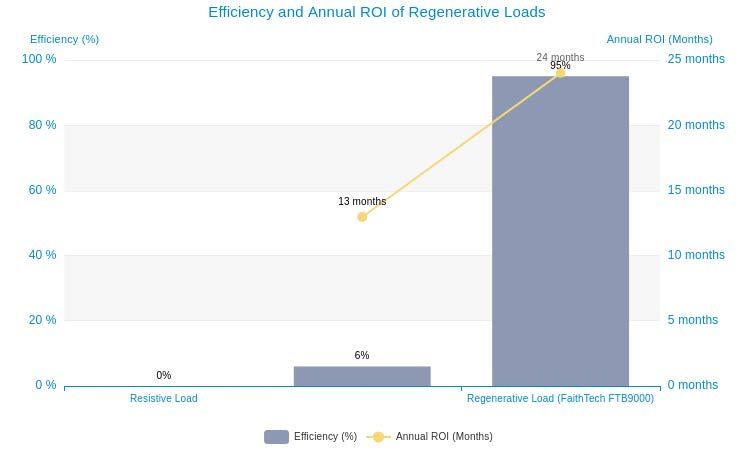
For instance, a facility that uses a 20 kW resistive load for extensive testing could save over $120,000 per year in electricity costs by switching to a bidirectional supply with 96% efficiency. The high efficiency of bidirectional supplies also means they operate cooler, which can extend the lifespan of components and reduce maintenance needs.
Versatility and Simplicity
Bidirectional power supplies combine two functions into one, simplifying test setups and reducing the number of instruments needed. Instead of having a separate DC power supply and an electronic load, a single bidirectional supply can handle both sourcing and sinking tasks. This all-in-one capability not only saves space in the lab or test bench but also streamlines the testing process. There is no need to switch cables or manually swap between a power supply and a load, which can introduce errors. The seamless transition between modes is managed internally by the supply, allowing continuous testing in both directions. This versatility is particularly advantageous in scenarios where the load can change direction (e.g., charging a battery and then discharging it back) or when testing devices that operate in both sourcing and sinking modes (like inverters or regenerative drives).
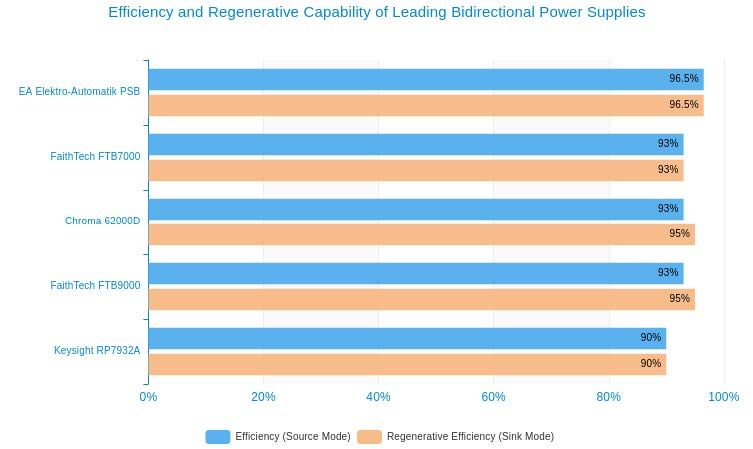
The following chart compares the efficiency and regenerative capabilities of several leading bidirectional power supply models.
In addition, bidirectional power supplies often offer a wider operating range in a single unit. Some models provide dual output ranges, allowing instant switching between high voltage/low current and low voltage/high current modes. This means a single supply can handle both high-power low-voltage tests and high-voltage low-power tests without needing multiple units. The ability to switch ranges quickly is ideal for dynamic testing conditions where the load requirements might change on the fly.
Enhanced Testing Capabilities
By providing bidirectional control, these supplies enable more comprehensive testing scenarios that would be difficult or impossible with unidirectional equipment. For example, testing a device that interacts with a battery or grid requires bidirectional power flow. With a bidirectional supply, you can simulate the battery charging the device and then the device discharging back to the battery, all in one setup. This capability is invaluable for testing battery management systems (BMS), where the BMS must control both the charge and discharge of a battery. It also allows testing of bidirectional converters (like EV chargers or grid-tied inverters) under realistic conditions.
Bidirectional power supplies also support dynamic and arbitrary waveform testing. The built-in waveform generator can produce complex voltage or current profiles, enabling tests that mimic real-world conditions such as voltage sags, swells, or load transients. This level of control is not typically available with separate instruments. Moreover, the high-speed response and accurate control allow precise simulation of sudden load changes or fault conditions, which is crucial for validating the reliability of power systems.
Improved Power Factor and Energy Efficiency
Modern bidirectional power supplies are designed with high power factor correction (PFC) circuits, ensuring that the input current drawn from the AC grid is highly sinusoidal and in phase with the voltage. This results in a power factor close to 1.0, which is important for reducing harmonic distortion and improving the efficiency of the facility’s power distribution. Unlike simple resistive loads that can draw distorted current and cause inefficiencies, bidirectional supplies with PFC operate efficiently and within regulatory limits. This is particularly beneficial when multiple supplies are used in parallel or when integrated into automated test systems that require high power levels.
The use of advanced power conversion techniques (such as soft-switching and wide-bandgap semiconductors) in bidirectional supplies further enhances their efficiency. These techniques reduce switching losses and allow higher operating frequencies, leading to smaller, lighter, and more efficient power conversion units. For instance, using silicon carbide (SiC) or gallium nitride (GaN) power devices can significantly boost efficiency and power density in bidirectional supplies. The result is a supply that can deliver high power with lower heat generation and energy loss, contributing to overall energy savings.
Advanced Control and Monitoring
Programmable bidirectional power supplies offer sophisticated control and monitoring features that greatly aid in testing and analysis. They allow users to set detailed test sequences and monitor electrical parameters in real-time. The inclusion of digital interfaces means they can be easily integrated into automated test equipment (ATE) systems, enabling continuous data logging and feedback control. This is especially useful in production environments where testing needs to be automated and repeatable. Additionally, many suppliers provide software that can visualize output waveforms, compare test results against specifications, and even perform data analysis. This advanced control and monitoring capability helps engineers quickly identify issues and optimize test conditions.
Space and Cost Savings
Using a single bidirectional power supply instead of separate units can lead to space savings and cost reduction. In a rack or lab bench, one instrument can replace two, which means less equipment to manage and fewer cables to route. This not only saves physical space but also simplifies the setup and reduces the risk of errors from cable swapping. In terms of cost, while bidirectional power supplies are generally more expensive than unidirectional supplies, the total cost of ownership can be lower when considering the savings in energy and maintenance. Over time, the energy saved by reusing power and the reduced cooling requirements can offset the initial cost of the supply. Moreover, the elimination of multiple instruments means fewer devices to purchase and maintain, which can be a significant cost advantage for larger test systems.
In conclusion, programmable bidirectional DC power supplies offer enhanced efficiency, flexibility, and functionality compared to traditional power supply setups. They enable more accurate and comprehensive testing, while also being environmentally friendly by recovering energy. The advantages in efficiency, versatility, and control make them a valuable asset in research, development, and production environments across various industries.
Example Solution: FaithTech Faith Power Supplies
One manufacturer at the forefront of providing high-performance bidirectional DC power supplies is FaithTech (www.faithtechate.com). FaithTech offers a range of programmable bidirectional DC power supplies under their “Faith Power” brand, designed to meet the diverse needs of modern power testing. Key products from FaithTech include:
FTB7000 Series: A wide-range, high-power bidirectional DC power source that integrates both power supply and regenerative load functions. The FTB7000 provides a 4U/50 kW power density, with voltage ranges from 500 V to 2250 V and current ranges from 225 A to 2880 A. It features a 5-inch touchscreen interface for easy operation and supports master-slave parallel operation of up to 10 units for expanded power capacity. This series is ideal for high-power testing in automotive electronics, energy storage, and fuel cell applications, where bidirectional energy flow and wide output range are critical.
FTB9000 Series: A 3U/18 kW bidirectional programmable DC power supply. The FTB9000 is a compact yet powerful solution with voltage ranging from 80 V to 1500 V and current from 25 A to 1200 A (multiple models available). It features high-speed transient response (less than 1.5 ms) and can seamlessly switch between source and load modes without manual intervention, avoiding voltage or current overshoot. The FTB9000 supports a variety of communication interfaces (LAN, USB, GPIB, CAN, etc.) and comes with a user-programmable sequence function for simulating power interruptions, voltage drops, and other dynamic events. This series is widely used in motor testing, battery packs, BMS, and energy storage system testing.
FTB Series (5 kW ~ ±180 kW): A modular and scalable family of bidirectional power supplies. The FTB series offers a broad range of power levels (5 kW up to ±180 kW) and can be configured in single-channel or multi-channel setups. Each unit is a regenerative bidirectional DC power supply that can act as both a power source and an electronic load, with efficiencies up to 95% for energy feedback. The FTB series supports parallel operation of multiple units, enabling extremely high power outputs (up to ±1800 kW in parallel configurations). It also includes advanced features like automatic line loss compensation, CV/CC priority control, and support for photovoltaic array simulation (optional). This series is designed for large-scale testing and high-power applications such as automotive battery testing, PV inverter testing, and industrial power electronics testing.
FaithTech’s bidirectional power supplies are built with high precision and reliability, meeting the stringent requirements of modern power testing. They come with comprehensive protection features (OVP, OCP, OPP, OTP, LVP) and comply with international safety standards. The user-friendly interface and software tools provided by FaithTech make it easy to set up and control complex test scenarios. For example, the FTB9000 series offers a dedicated control software that can read test data, generate graphical reports, and export results, streamlining the testing process.
In summary, FaithTech’s bidirectional DC power supplies exemplify the capabilities and benefits discussed in this article. They are engineered to deliver efficient, precise, and bidirectional power control, enabling users to perform a wide range of tests with a single instrument. Whether it’s simulating a battery, testing an EV charger, or validating a power electronics converter, FaithTech’s solutions provide the performance and flexibility needed for today’s demanding power testing applications.
Conclusion
Programmable bidirectional DC power supplies are versatile tools that have become essential in various fields of engineering and testing. Their ability to source and sink power allows for the simulation of real-world conditions and the testing of bidirectional energy systems, from batteries and solar panels to electric vehicles and power grids. The key features – high efficiency, seamless mode switching, programmable control, and robust protection – make them far superior to traditional setups in terms of efficiency, flexibility, and safety. By enabling energy recovery and reducing heat generation, bidirectional power supplies not only improve the accuracy of testing but also contribute to sustainability and cost savings.
As industries continue to evolve towards more electrified and energy-efficient systems, the importance of bidirectional power supplies will only grow. They are at the heart of testing battery technologies, renewable energy integration, electric vehicle systems, and advanced power electronics. Companies like FaithTech are leading the way in providing cutting-edge solutions that meet these growing needs. In conclusion, programmable bidirectional DC power supplies are indispensable for engineers and researchers who demand precise, efficient, and comprehensive control over DC power flow. By leveraging these devices, professionals can accelerate innovation and ensure the reliability of the next generation of power systems.
Reference:
[1]FTB9000 series Bidirectional programmable DC power supply ...
https://www.faithtechate.com/product/ftb9000-series-bidirectional-programmable-dc-power-supply/
[2]FTB7000 Series Wide-range high-power bidirectional DC ...